 Woolf Programs
 Davis, MSc in Management
 ESCP, EMIB






Key Takeaways
- Machine Learning (ML) is the foundation, Deep Learning (DL) builds on it, and Generative AI (Gen AI) sits on top as an application layer
- Generative AI is currently the fastest-growing segment in India’s AI job market
- Machine Learning remains essential for data science and core AI roles
- The right choice depends on whether you want quick entry, long-term depth, or research-level expertise
Understanding the AI Family Tree
How Machine Learning, Deep Learning, and Generative AI relate to each other
The use of these terms interchangeably creates a lot of confusion.
An easier way to explain the distinction between GenAI, ML, and DL is to imagine it as layers, not as distinct domains.
- The bottom layer is Machine Learning
- Deep Learning is a more advanced branch of machine learning
- Generative AI is built on top of both
An analogy that comes in handy in education:
The backbone is Machine Learning, the framework is Deep Learning, and the product that everyone actually interacts with is Generative AI.
Below is a simple hierarchy:
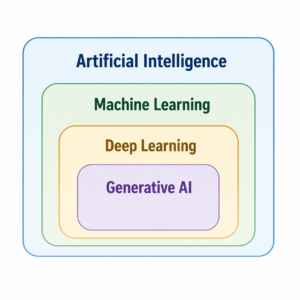
This hierarchy is why the vast majority of modern tools, such as ChatGPT or Gemini, do not exist independently, but instead are based on all the tools beneath them.
What Is Machine Learning?
Definition and how it works (plain English)
Machine Learning is literally teaching computers to learn trends based on data, rather than training them using constant rules.
You do not feed a system with instructions such as: When X occurs, do Y; you feed it with data and allow it to determine the relationship.
For example, spam filters learn what spam looks like by analysing thousands of emails. They do not have to be manually programmed in every case.
This is why Machine Learning became the starting point for most AI learning path discussions in India.
Real-world ML use cases in Indian companies
Machine Learning is already deeply embedded in Indian businesses.
- Banks use it for fraud detection
- E-commerce platforms use it for recommendations
- Fintech apps use it for credit scoring
- OTT platforms use it for content suggestions
Companies such as Flipkart, Paytm, and Zomato rely heavily on ML systems to personalise user experiences.
This is also why machine learning career India remains relevant even with newer technologies emerging.
Skills and tools an ML professional needs
To work in ML, you typically need:
- Python or R
- Understanding of supervised learning and algorithms
- Data handling and preprocessing
- Basic statistics
Frameworks like Scikit-learn and TensorFlow are commonly used.
It is not only a matter of coding here, but of an understanding of data, and of the way models learn through it.
What Is Deep Learning?
How it differs from traditional ML
Deep Learning is a more advanced version of Machine Learning that uses neural networks.
It processes data in more complicated forms by using layered structures (or neural networks) instead of simple models.
This is what enables systems to identify images, comprehend speech, and process language on a more thorough level.
In short, if ML learns patterns, Deep Learning learns patterns within patterns.
Where deep learning is used in India today
Deep Learning is widely used in areas like:
- Face recognition systems
- Voice assistants
- Medical imaging
- Autonomous systems
Indian startups in healthcare and fintech are increasingly adopting DL models for predictive analytics and automation.
This is why deep learning jobs India often require stronger technical backgrounds compared to entry-level ML roles.
What Is Generative AI?
How GenAI is built on top of ML and deep learning
Generative AI is not separate from ML or DL. It is built on top of them.
It uses deep learning models, especially transformer architectures, to generate content—text, images, code, and more.
This is where concepts like LLMs (Large Language Models) and NLP come into play.
Examples: ChatGPT, Gemini, Midjourney, Stable Diffusion
These tools are the most visible part of AI today:
- ChatGPT generates text and conversations
- Gemini integrates AI across Google products
- Midjourney creates images
- Stable Diffusion generates visual content
They all rely on deep learning models trained on massive datasets.
Why GenAI is the fastest-growing segment in India right now
India’s AI market is expected to reach $8 billion by 2025 at a cumulative annual growth rate (CAGR) of more than 40%, according to NASSCOM (2025). Driven by vertical SaaS, agentic platforms, and extensive enterprise usage, generative AI (GenAI) is a major segment with 890+ companies (3.7X growth by H1 2025), cementing India as a top global AI hub.
Similarly, McKinsey estimates that generative AI could add billions in productivity value across industries globally.
This explains why many students are now prioritising GenAI when choosing which AI course to learn.
Source: ibef, mckinsey
Side-by-Side Comparison: ML vs Deep Learning vs Generative AI
|
Dimension |
Machine Learning | Deep Learning |
Generative AI |
| Definition | Learning from data | Advanced ML using neural networks | AI that generates content |
| Skills needed | Statistics, coding | Neural networks, advanced math | Prompting + ML basics |
| Coding level | Moderate | High | Low to moderate |
| India job demand | High | Moderate to high | Rapidly growing |
| Avg salary | ₹8–25 LPA | ₹12–35 LPA | ₹10–40+ LPA |
| Best for whom | Data-focused roles | Research/advanced roles | Fast-entry, applied roles |
Disclaimer: The above salary estimates are based on AmbitionBox, LinkedIn Jobs India, and can vary based on the skillset and experience of the candidate.
Which Should You Learn First? (Based on Your Goal)
If you want to get a job in 3–6 months, learn Generative AI
Generative AI offers the fastest entry.
You can start building projects quickly without going deep into algorithms. Many roles in ChatGPT jobs India or automation workflows fall into this category.
If you want to become a data scientist, start with ML
Machine Learning is still the foundation for data science.
If your goal is analytics, prediction models, or working with structured data, ML is the logical starting point.
If you want to build AI models from scratch, go deep learning
Deep Learning is where model creation happens.
This path is more technical and requires patience, but it leads to roles like LLM engineer or research-focused positions.
Do you need ML knowledge before learning Generative AI?
Not always, but it helps.
You can start with Generative AI directly, but understanding ML concepts later improves your depth and career options.
Bottom Line Recommendation
If you’re starting from scratch, the most practical path in India right now is: Start with Generative AI, learn ML fundamentals, and then move into deeper AI roles if needed. This layered approach aligns better with how the industry is evolving.
In our experience working with thousands of learners, those who combine applied GenAI skills with foundational ML understanding tend to perform better in the job market.
Programs like MSM Grad’s AI curriculum are designed around this approach, aligned with NASSCOM standards, ensuring both industry relevance and long-term growth.
FAQ
1. Is generative AI a subset of machine learning?
Yes. Generative AI is built on top of machine learning and deep learning.
2. Can I learn generative AI without knowing ML?
Yes, especially at the beginner level. But ML knowledge helps in advanced roles.
3. Which has more jobs in India: ML or generative AI?
Currently, ML has more total roles, but Generative AI is growing faster.
4. What is the salary difference between an ML engineer and a GenAI engineer in India?
GenAI roles can match or exceed ML salaries, especially in startups and product companies.
5. Which course covers all three: ML, deep learning, and generative AI?
Programs aligned with industry frameworks, like MSM Grad’s AI programs, typically cover all three areas in a structured path.