
 Woolf Programs
 Davis, MSc in Management
 ESCP, EMIB






Why the LLM You Learn Matters For Your Career
Many individuals are currently taking AI tools in the wrong direction. They’re trying to “pick the best one,” as if this is like choosing between two software tools and sticking with it for years. This is not how this space functions. These models are changing within a few months, or even sooner. It is not only about which tool you learn, but also whether you know how these systems in general behave.
That being said, the tool you begin with does influence your initial experience. Choose something too technical, and you will be stuck early. When you choose something too small, you will not see the possibilities. And when you attempt to know it all in one sitting, you will only know not very much of it.
This is why the question ChatGPT vs Gemini vs Claude vs Llama India keeps being raised. People are not merely comparing tools. They are trying not to waste time.
How Indian Companies Are Actually Using These Tools
If you zoom out and look at adoption patterns in India, a few things become clear.
First, companies are not standardising around a single model yet. Unlike traditional software where one tool dominates, AI adoption is fragmented. Different teams inside the same company might use different tools depending on what they need.
Second, adoption is heavily influenced by existing infrastructure.
Companies already working on Microsoft ecosystems are naturally integrating OpenAI tools. Those deeply embedded in Google Workspace are exploring Gemini because it fits into Docs, Sheets, Gmail without friction. Startups and product teams are experimenting with open-source models like Llama because they want control over cost and data.
And third, most companies are still in the “applied use” phase, not the “build your own AI” phase. That means they’re using these tools to improve workflows rather than creating new models from scratch.
That’s important because it tells you something about where the jobs are.
What Job Descriptions Are Actually Asking For
If you scan job listings in India right now, especially for roles in marketing, product, operations, or even early-stage AI roles, you’ll notice that very few of them say “must know Claude” or “must know Gemini.”
Instead, they say things like:
- Experience with AI tools and automation
- Familiarity with prompt engineering
- Ability to use LLMs for workflows
ChatGPT shows up more often simply because it’s widely used. In many cases, it’s become shorthand for “experience with AI tools.” But here’s the part that matters: employers are not testing tool loyalty. They’re testing problem-solving. They want to know: can you take a messy task and use AI to simplify it? Once you understand that, the comparison becomes easier.
ChatGPT (OpenAI) – The Most Practical Starting Point
There’s a reason ChatGPT still dominates conversations.
It’s not just early-mover advantage. It’s usability.
The interface is simple, the responses are generally reliable, and most importantly, it works well across a wide range of tasks without requiring much setup.
For someone entering this space, that matters more than advanced features.
Where ChatGPT Actually Fits In Day-to-Day Work
If you look at how professionals are using ChatGPT in India right now, it’s rarely for one big task. It’s for dozens of small ones.
Writing drafts. Summarising reports. Generating ideas. Cleaning up emails. Breaking down complex topics.
Individually, these tasks are not groundbreaking. But together, they reduce time spent on repetitive work.
That’s why ChatGPT adoption is high in:
- Marketing teams
- Content roles
- Operations and support functions
- Early-stage product teams
It’s not because it’s the most powerful tool. It’s because it’s the most usable.
The Role Of GPT-4o And Why It Matters
With newer models like GPT-4o, the gap between “basic AI” and “usable AI” has narrowed further.
Responses are faster, more accurate, and better at handling mixed inputs. That makes it easier to rely on the tool for actual work instead of just experimentation. For professionals, this means the tool is no longer just for ideation. It’s part of execution.
Gemini (Google) – Built For Workflows, Not Just Outputs
Gemini is often compared directly to ChatGPT, but in practice, it behaves differently. Its biggest advantage is not just capability, it’s integration.
Why Integration Matters More Than Features
Most professionals don’t work inside standalone tools.
They work inside systems, including email, documents, and spreadsheets. That’s where most of their time goes. Gemini fits into that environment.
Instead of generating something in a separate window and then copying it over, it works inside Docs, Sheets, and Gmail. That reduces friction. And in large organisations, small reductions in friction scale quickly.
Where Gemini Performs Well
Gemini tends to do well in:
- Research-heavy tasks where information needs to be gathered and structured
- Data-related tasks involving Sheets and structured inputs
- Multimodal tasks where text, images, and data need to work together
For developers, it also integrates into coding environments, which makes it useful as a secondary tool.
Claude (Anthropic) – When Depth Matters More Than Speed
Claude doesn’t dominate headlines, but it fills a gap that other tools sometimes struggle with.
Handling long, complex inputs without losing context.
Reasons why this matters in real work
A lot of professional work isn’t short-form.
It involves:
- Reports
- Contracts
- Policy documents
- Research papers
These are not tasks where you can just paste a paragraph and get a useful answer.
Claude’s strength lies in maintaining coherence over long inputs. It doesn’t “forget” earlier context as quickly as some other tools.
That makes it useful in:
- Legal teams
- Finance roles
- Research-heavy environments
- Content strategy work
Llama (Meta) – Not A Tool, But A Capability Layer
Llama is often misunderstood because it’s grouped with tools like ChatGPT and Gemini. It’s not really the same thing. It’s a model that companies can use to build their own systems.
Why startups and developers care about Llama
The biggest advantage here is control.
With Llama, companies can:
- Run models on their own infrastructure
- Customise outputs
- Avoid recurring API costs
- Handle sensitive data internally
This is particularly relevant in India, where cost sensitivity and data privacy concerns play a role.
Why most professionals don’t start here
For non-technical users, Llama is not the starting point. It requires setup, understanding of infrastructure, and some level of technical involvement. But if you’re aiming for roles in AI development or product building, it becomes important over time.
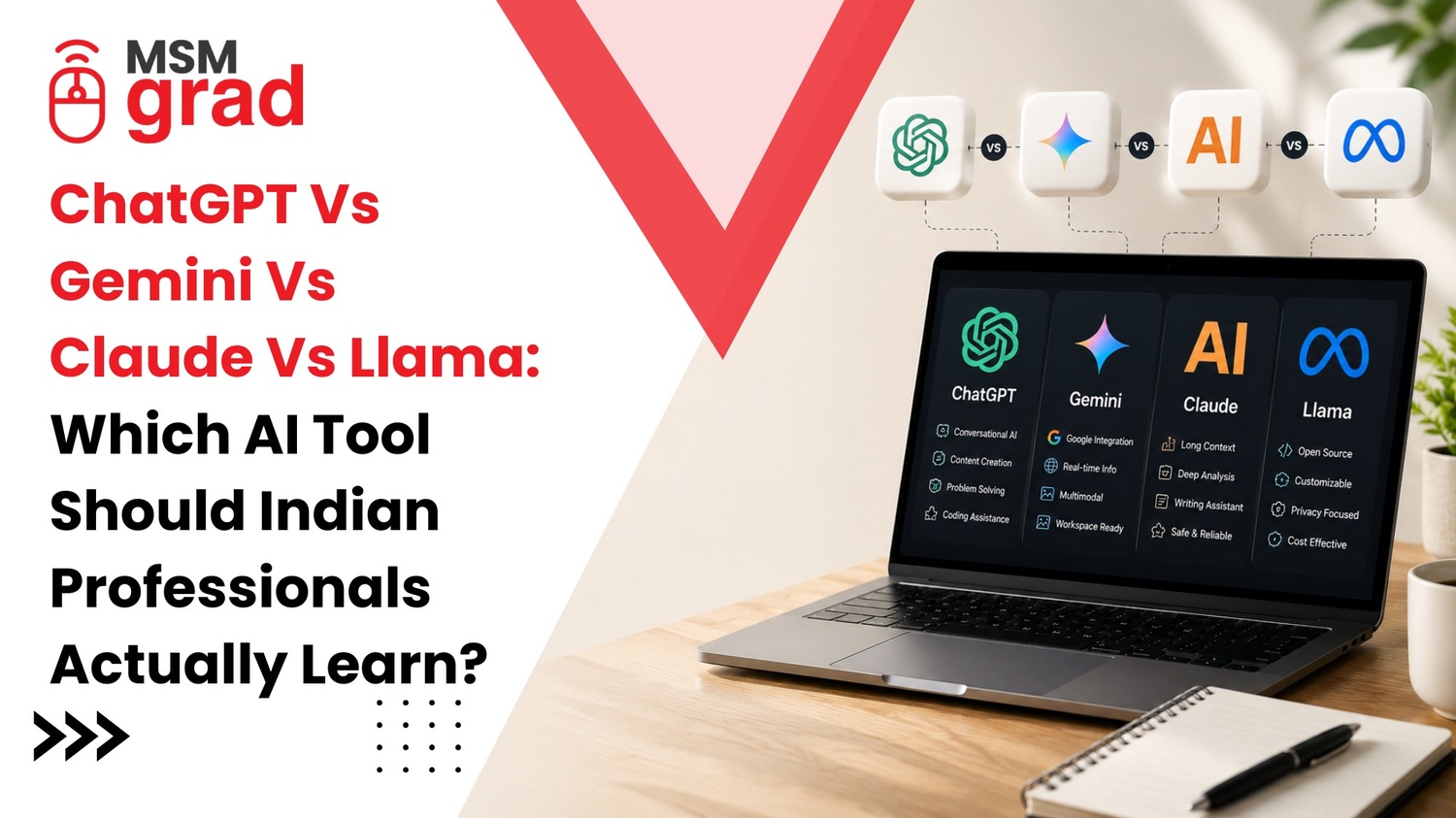
Head-to-Head Comparison (What Actually Matters)
| Dimension | ChatGPT | Gemini | Claude | Llama |
| Ease of Use | Very High | High | Moderate | Low |
| Best For | General workflows | Integrated work | Long content | Custom systems |
| India Adoption | Very High | Growing | Niche | Developer-focused |
| Coding Use | Moderate | High | Low | High |
| API Access | Yes | Yes | Yes | Yes (self-hosted) |
| Job Demand | High | Growing | Moderate | Niche |
(Based on aggregated observations from LinkedIn Jobs, Naukri listings, and industry usage trends.)
So Which One Should You Learn?
This is where people expect a definitive answer, but it doesn’t really work that way. What you should learn depends less on the tool and more on your role.
- If you’re a non-technical professional, starting with ChatGPT makes sense. It gives you a clear understanding of how prompts work and how outputs can be shaped.
- If you’re a developer, you’ll eventually need to work with multiple systems, including Gemini for integrations and Llama for building.
- If you’re in content or marketing, combining ChatGPT with something like Claude gives you both speed and depth.
Why MSM Grad focuses On Multiple Tools
One of the mistakes a lot of learners make is getting too attached to a single tool.
The reality is that tools will change. What doesn’t change is the underlying skill leading to understanding how to use AI in workflows.
That’s why programs like MSM Grad expose learners to multiple LLMs instead of focusing on just one. The goal is to build adaptability, not dependency.
Final Thought
The question best LLM for Indian professionals 2026 sounds like it has a clear answer. It doesn’t. Because the real advantage doesn’t come from choosing the “right” tool. It comes from knowing how to use whichever tool is available to solve a problem. Start with one. Understand it properly. Then expand.That’s what actually makes a difference.