 Woolf Programs
 Davis, MSc in Management
 ESCP, EMIB



When talking about an online degree to most Indian students, the response is typically divided into two distinct groups.
The first group believes that online education is the future. The second group asks right away, “But is it recognized?
Frankly, that’s a reasonable question.
Online learning has a bad reputation that’s been around for years. Many people linked it to short courses, unrecognized institutions, or courses that were not taken seriously by employers. However, things are very different in 2026.
Many of the world’s most highly regarded universities are providing online degrees today. Students from online programs are employed by large companies. And thousands of working professionals are getting U.S. credentials without leaving the workplace or moving abroad.
However, even in this transition, some Indian students have misconceptions about the workings of a legitimate online degree in the United States.
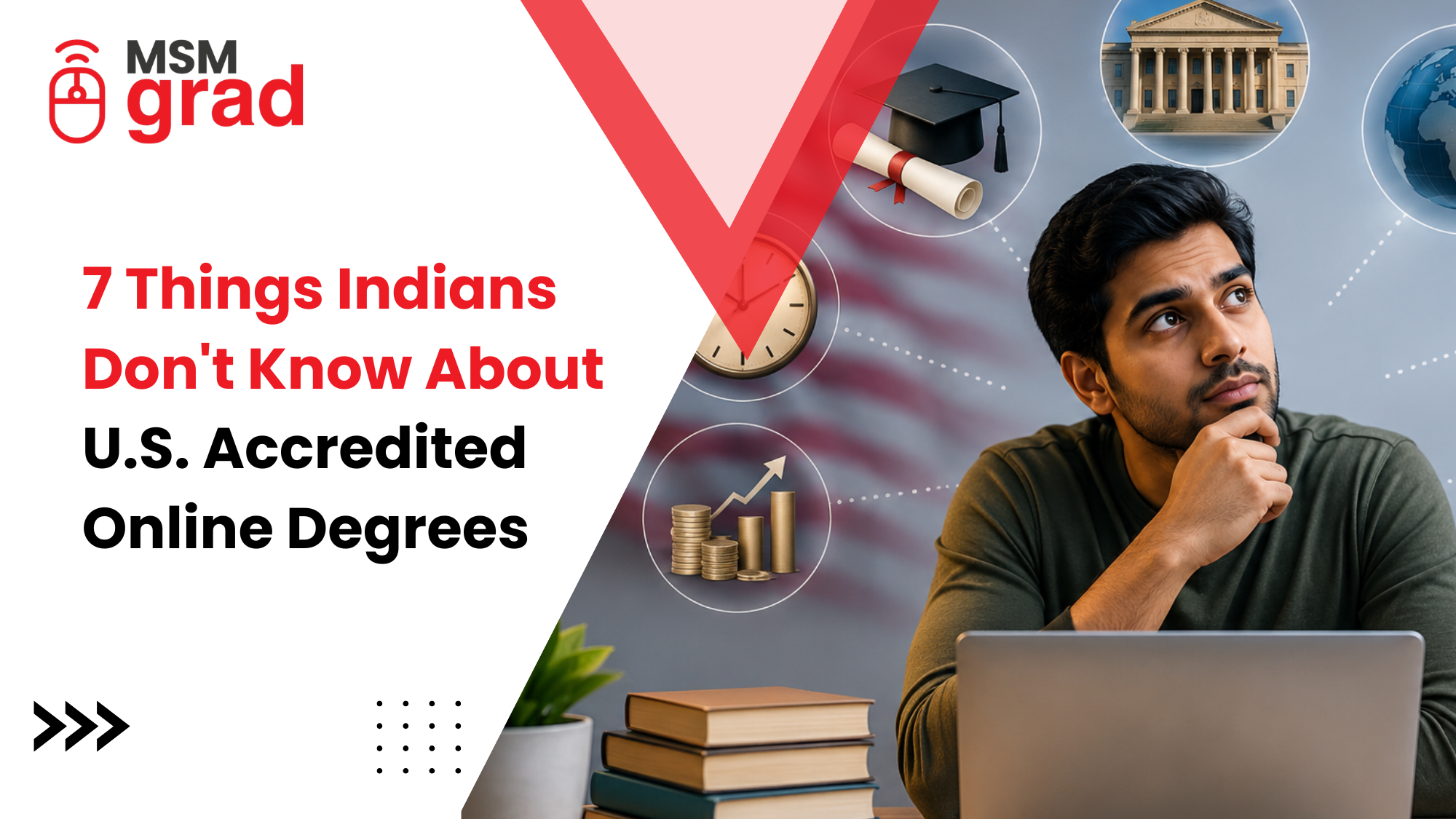
If you’re considering a US-accredited degree India learners can pursue from home, here are seven things most people don’t know, and why they matter when choosing a program.
1. Accreditation Matters More Than Whether the Degree Is Online
One of the biggest misconceptions is that employers care primarily about whether a degree was completed online.
In reality, most employers care far more about accreditation.
Think of accreditation as a quality assurance system. It confirms that a university meets specific academic standards established by recognized accrediting bodies.
Without accreditation, a degree may have limited value regardless of whether it was earned online or on campus.
With accreditation, the degree carries institutional credibility.
That’s why when evaluating any U.S. university, the first question shouldn’t be:
“Is this online?”
It should be:
“Is this accredited?”
The answer often tells you much more about the degree’s value.
2. Many Employers Never Know You Studied Online
This is a surprise to many students.
Your diploma will not read “online degree” in many instances.
It just specifies the degree and the university it got from.
For instance, two students from the same University may graduate, one on campus and one online, and the qualification may be the same.
When looking at a résumé, employers are typically looking at:
- The university
- The degree earned
- Relevant skills
- Professional experience
Not whether lectures were attended in a classroom or through a learning platform.
As remote learning has become mainstream, the distinction has become far less important than many people assume.
3. A HLC Accredited University Carries Significant Recognition
When researching U.S. institutions, you’ll often encounter references to regional accreditation.
One of the most respected accrediting bodies is the Higher Learning Commission (HLC).
An HLC accredited university undergoes extensive reviews related to academic quality, governance, student outcomes, and institutional effectiveness.
For students, this matters because accreditation affects:
- Degree credibility
- Employer recognition
- Academic quality standards
- Transfer opportunities
- Further education pathways
Many students spend weeks comparing rankings while overlooking accreditation entirely.
In reality, accreditation is often the more important indicator.
4. Studying in the U.S. Doesn’t Always Require Moving to America
For decades, studying in the United States meant a major life change.
Students had to:
- Apply for visas
- Relocate internationally
- Cover accommodation costs
- Manage living expenses abroad
That model still exists, of course.
But it’s no longer the only option.
Today, many professionals choose to study in USA from home while continuing their careers, managing family responsibilities, and avoiding relocation costs.
For working professionals especially, this flexibility can be transformative.
Instead of putting life on hold for two years, they continue earning, gaining experience, and studying simultaneously.
5. The Real Cost Difference Is Bigger Than Most Students Realize
When people compare tuition fees, they often overlook the biggest expense associated with overseas education.
Living costs.
Housing, transportation, healthcare, food, and daily expenses frequently add tens of thousands of dollars to the total cost of studying abroad.
Online programs eliminate many of these expenses.
Consider the difference:
A traditional international student may pay for:
- Tuition
- Accommodation
- Utilities
- Insurance
- Travel
- Daily living costs
An online learner typically pays primarily for tuition.
That’s one reason many professionals are exploring an online US degree for Indians rather than pursuing a conventional overseas route.
The academic outcome may be similar, but the financial equation can look very different.
6. U.S. Degrees Are Increasingly Valued for Skills, Not Just Credentials
A few years ago, many professionals pursued degrees mainly for the qualification itself.
Today, employers are asking different questions.
Can you lead teams?
Can you solve business problems?
Can you communicate effectively?
Can you work across global environments?
The strongest U.S. programs increasingly focus on practical application rather than academic theory alone.
This is especially important in fields like management, business, technology, and analytics.
Employers aren’t just hiring people with degrees.
They’re hiring people who can apply what they’ve learned.
That’s one reason programs that integrate real-world projects, case studies, and leadership development continue gaining attention.
7. Online Degrees Can Create Global Career Opportunities
Many students initially explore online education because of convenience.
But convenience often becomes secondary once they realize the broader career implications.
A recognized U.S. qualification can help professionals:
- Apply for multinational roles
- Pursue leadership positions
- Strengthen promotion opportunities
- Expand international career prospects
- Build credibility across global organizations
Of course, no degree guarantees a job.
That’s true whether you study online or on campus.
However, a recognized qualification from an accredited institution can strengthen your profile in increasingly competitive job markets.
What This Means for Indian Professionals in 2026
The conversation around online education has changed dramatically.
The question is no longer:
“Are online degrees legitimate?”
The better question is:
“Which online degrees offer genuine academic value and employer recognition?”
That’s where accreditation becomes essential.
When evaluating a program, look beyond marketing claims.
Check:
- Institutional accreditation
- Program quality
- Faculty credentials
- Student support
- Industry relevance
- Career outcomes
These factors usually matter far more than whether classes happen in a physical classroom.
How MSM Grad Helps Professionals Earn a U.S. Master’s Degree
Many professionals want a U.S. qualification but struggle with practical realities.
Leaving a job isn’t always possible.
Relocating isn’t always feasible.
And traditional international study isn’t always affordable.
That’s where MSM Grad’s Master of Science in Management pathway has attracted attention from working professionals seeking flexibility without sacrificing academic credibility.
The program is designed for learners who want to gain management and leadership expertise while continuing their careers.
Instead of stepping away from professional responsibilities, students can pursue higher education alongside them.
For many learners, this creates a more sustainable path toward career advancement than pausing work for a full-time overseas program.
The Bottom Line
The biggest mistake students make when evaluating online education is focusing on delivery format instead of academic quality.
A respected, accredited U.S. qualification is still a respected, accredited U.S. qualification.
Whether you study from a campus in America or from your home in India, what ultimately matters is:
- The university
- Its accreditation
- The skills you develop
- How you apply them in your career
As online learning continues becoming part of mainstream higher education, understanding these distinctions is more important than ever.
For professionals exploring a US accredited degree India learners can pursue without relocating, the opportunity today looks very different than it did even five years ago.
And for many, that difference is opening doors that once seemed out of reach.
FAQs
1. What is a US accredited degree India students can pursue online?
A U.S. degree awarded by an accredited American university that can be completed remotely from India.
2. Why is accreditation important?
Accreditation verifies academic quality and institutional credibility, making degrees more widely recognized by employers and educational institutions.
3. What is an HLC accredited university?
An HLC accredited university is accredited by the Higher Learning Commission, one of the most recognized regional accrediting bodies in the United States.
4. Can I study in USA from home and earn a valid degree?
Yes. Many accredited U.S. universities now offer online programs that allow students to complete their degrees remotely.
5. Is an online US degree for Indians respected by employers?
In most cases, employers focus on the university’s accreditation, reputation, and the candidate’s skills rather than the delivery format of the degree.