 Woolf Programs
 Davis, MSc in Management
 ESCP, EMIB






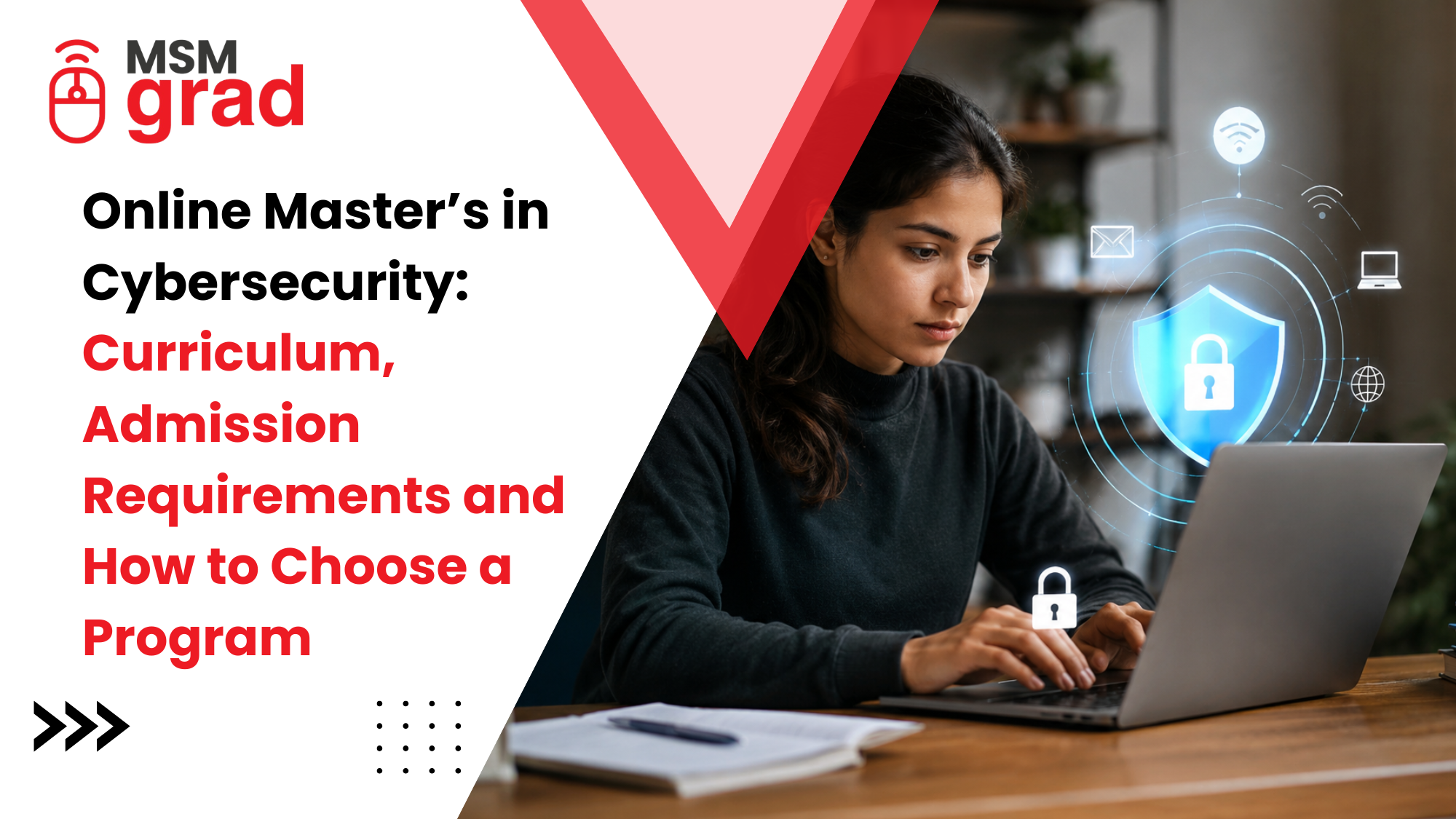
Choosing a cybersecurity master’s online is not always straightforward. One program may be listed as an MSc Cybersecurity online. Another may be a computer science degree with a cybersecurity specialization. Some are full postgraduate degrees, while others are short certificates with similar-sounding names.
So, if you are comparing a cyber security masters degree online, do not stop at the title. Check the curriculum, awarding body, admission rules, learning format, fees, recognition, and the kind of support offered to working professionals.
Cybersecurity skills remain important because organizations are still struggling to find the right talent. The World Economic Forum’s Global Cybersecurity Outlook 2025 reported that the cyber skills gap increased by 8 percent since 2024, with two in three organizations facing moderate-to-critical skills gaps.
What is an online master’s in cybersecurity?
An online master’s in cybersecurity is a postgraduate program focused on protecting digital systems, networks, cloud environments, data and organizational infrastructure. It usually covers both technical and risk-focused areas, so students understand not only how attacks happen, but also how security decisions are made.
This degree may suit information technology graduates, software professionals, network engineers, security analysts, cloud professionals and career changers with some technical preparation.
It is different from a short certification. A certification may prepare you for one exam, tool or skill area. A master’s degree is broader. It usually includes multiple modules, academic assessments, projects and sometimes a capstone or research component.
That does not mean a degree is always better. If you are new to cybersecurity, a certification may be a good first step. If you want deeper postgraduate study, a cybersecurity master’s program may make more sense.
Typical cybersecurity master’s curriculum
Every university designs its own curriculum, so students should check the official module list before applying. Still, many programs include a mix of these subjects:
| Subject area | What students usually study |
| Network and information security | Protecting systems, networks and data |
| Cloud security | Securing cloud platforms, access and workloads |
| Cryptography | Encryption, keys and secure communication |
| Ethical hacking | Testing weaknesses legally and responsibly |
| Cyber risk management | Identifying and reducing organizational risk |
| Digital forensics | Investigating incidents and handling evidence |
| Governance and compliance | Understanding security policies and regulations |
| Incident response | Detecting, containing, and recovering from attacks |
| Security architecture | Designing safer systems from the start |
| Final project or research | Applying learning to a focused cybersecurity problem |
A good program should not feel like a list of random tools. The subjects should connect clearly, from technical defense to business risk and security planning.
Skills students may develop
Cybersecurity is technical, but the strongest professionals also know how to explain risk clearly. A security issue may start inside a system, but the decision often reaches managers, legal teams, finance teams or customers.
Students may build skills in threat analysis, vulnerability assessment, security planning, incident management, cloud security, risk assessment, documentation and communicating security risks to business leaders.
A 2025 research paper analyzing 12,161 cybersecurity job ads and 49,002 Stack Overflow posts found that communication and project management were among the most important soft skills, while technical skill demand varied by role.
Common admission requirements
Admission requirements vary by institution. Students should not assume that GRE, coding experience, or professional experience is always required.
Common requirements may include:
| Requirement | Why it matters |
| Bachelor’s degree | Confirms postgraduate eligibility |
| Academic transcripts | Shows previous academic record |
| English-language proficiency | May be needed for international applicants |
| CV or résumé | Shows work experience and projects |
| Statement of purpose | Explains goals and program fit |
| Technical knowledge | Helps with security and computing modules |
| Identification documents | Needed for application records |
Applicants without a cybersecurity background should ask about prerequisites. Basic comfort with networking, operating systems, cloud concepts, and simple scripting can make the program easier to handle.
How online learning works
An online cyber security degree can be flexible, but it is not automatically easy. Some programs use live classes. Others rely more on recorded lectures. Some are self-paced, while others follow a cohort model.
Before applying, check how the program is actually delivered. Are live sessions required? Are recordings available? Are there virtual labs? How are projects assessed? Can working professionals manage the weekly workload?
A credible online program should give students structure, feedback and practical work. Cybersecurity cannot be learned properly through theory alone.
How to choose the right program
This is where students should spend the most time. A strong cyber security masters degree online should be clear about what it awards, who awards it, and how students graduate.
Use this checklist:
| What to check | Why it matters |
| Exact degree title | Avoid confusion between degrees and certificates |
| Institution and awarding body | Confirms who grants the qualification |
| Accreditation or regulatory status | Helps assess credibility and recognition |
| Curriculum depth | Shows whether the program is serious enough |
| Labs and projects | Cybersecurity needs practice |
| Faculty support | Students need guidance in technical subjects |
| Duration and flexibility | Important for working professionals |
| Total fees | Helps compare value realistically |
| Recognition in your country | Useful for employment or further study |
| Graduation requirements | Check exams, projects, thesis or capstone |
Do not choose a program only because the name sounds strong. A weaker program with a strong title is still a weak program.
MSM Grad’s Online Cybersecurity Master’s Program Through Woolf
For professionals looking for a flexible postgraduate route, MSM Grad offers an online cybersecurity master’s program through Woolf.
The course name is Master of Science in Computer Science, Cybersecurity. It is designed for learners who want postgraduate study in cybersecurity while keeping the flexibility of online learning. The program is delivered 100% online, carries 90 ECTS credits, is mapped at EQF Level 7, and offers a flexible 12 to 24 month study pace.
Through Woolf, the program is regulated by Malta’s Malta Further and Higher Education Authority, giving learners a European higher education framework to consider while comparing online cybersecurity options.
Before applying, students should review the curriculum, admission requirements, tuition details, learning format and graduation requirements to make sure the program fits their academic background and career goals.
Is an online cybersecurity master’s worth it?
It can be worth it if the program matches your goals, current skill level and budget. It may help professionals who want deeper cybersecurity knowledge, structured postgraduate learning and stronger confidence in technical and risk-focused areas.
It may not be the right step if you only want a quick job switch. In that case, a beginner certification, lab-based course or networking foundation may be a better starting point.
No program can guarantee employment, salary growth or promotion. The value depends on the program quality, your effort, practical projects, interview skills, experience, and how well you apply what you learn.
FAQs
Can I pursue an online master’s in cybersecurity without a technical background?
Possibly, depending on the program. Non-technical learners should prepare with networking, operating systems, cloud basics and security fundamentals before starting.
Does a cybersecurity master’s require coding?
Not always at an advanced level, but basic scripting helps. Python, Linux commands and simple automation can be useful.
How long does an online cybersecurity master’s take?
It varies by institution. The MSM Grad and Woolf pathway lists a flexible 12 to 24 month study pace.
What subjects are usually covered?
Common subjects include network security, cloud security, cryptography, ethical hacking, risk management, digital forensics, governance, compliance and incident response.
Is a cybersecurity master’s different from a certification?
Yes. A certification is usually narrower. A master’s degree is broader and usually includes multiple modules, projects and academic assessments.
Can I complete it while working?
Many online programs are designed for working professionals, but students should check weekly workload, class timings and assessment deadlines before applying.
Final thoughts
A cyber security masters degree online can be useful, but only when the program is credible, practical and aligned with your goals. Compare the title, awarding body, curriculum, learning format, recognition, support and graduation requirements before deciding.
Explore the Woolf cybersecurity program through MSM Grad to review its curriculum, learning format and admission requirements.