 Woolf Programs
 Davis, MSc in Management
 ESCP, EMIB






Software, cloud delivery and cybersecurity now sit much closer together than they did a few years ago. Developers are expected to understand secure coding. DevOps teams are expected to protect pipelines. Security teams are expected to work earlier in the software lifecycle, not only after an app is already live.
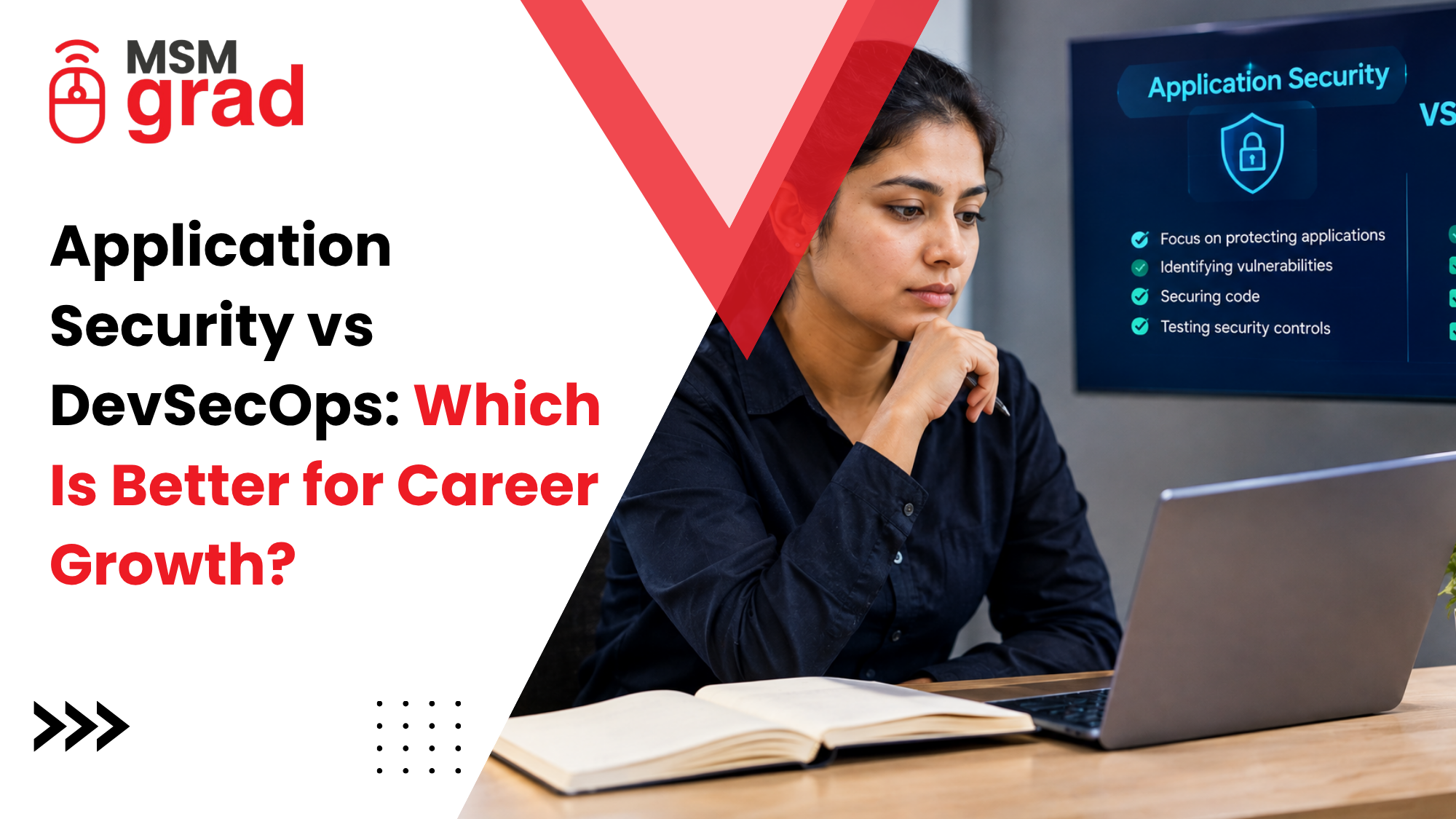
That is why many technical professionals compare application security vs devsecops. The terms overlap, but they are not the same. Application security is a security discipline focused on protecting software. DevSecOps is an operating approach that brings security into development, operations, automation and delivery.
Application Security vs DevSecOps at a Glance
| Factor | Application security | DevSecOps |
| Main objective | Identify and reduce software vulnerabilities | Integrate security across development and operations |
| Scope | Applications, code, APIs and dependencies | Code, pipelines, infrastructure and deployment |
| Common work | Testing, threat modeling, secure review and remediation | Automation, CI/CD controls and secure delivery |
| Coding requirement | Moderate to high, depending on role | Usually moderate to high |
| Typical background | Development, penetration testing or security | DevOps, cloud, development or platform engineering |
The short answer: application security may suit people who want deep software security expertise. DevSecOps may suit people who want broader security work across code, cloud, automation and delivery pipelines.
What Is Application Security?
Application security, often called AppSec, focuses on protecting software from design to deployment. It includes secure software development, threat modeling, code review, vulnerability testing, API security, software composition analysis and helping teams fix weaknesses.
OWASP describes its Top 10 as a standard awareness document for developers and web application security, covering common web application risks that security and development teams should understand.
Application security work often starts with questions like:
- Is the app handling authentication properly?
- Can users access data they should not see
- Are APIs exposed?
- Are dependencies vulnerable?
- Is sensitive data protected?
- Can attackers abuse input fields, business logic or session handling?
This field is a good fit for developers, penetration testers, quality assurance professionals and cybersecurity learners who enjoy understanding how software breaks.
What Is DevSecOps?
DevSecOps means building security into the software delivery process instead of adding it at the end. It connects development, security and operations through automation, shared responsibility and continuous improvement.
In practice, DevSecOps may include CI/CD pipeline security, automated scanning, infrastructure as code checks, secrets management, container security, Kubernetes security, cloud security and continuous monitoring. GitLab describes DevSecOps as including application security practices in every stage of software development, including secret detection and CI/CD pipeline scans to prevent credential leaks.
A DevSecOps professional may not spend the whole day manually reviewing code. They may build controls that help developers ship safer code repeatedly.
How Application Security and DevSecOps Differ
Scope
Application security is narrower and deeper. It focuses mainly on software, APIs, code and vulnerabilities. DevSecOps is wider. It includes application security, but also covers pipelines, cloud environments, infrastructure, containers and delivery processes.
Ownership
In application security, a security team or product security team may review code, guide developers and track vulnerabilities. In DevSecOps, ownership is more shared. Developers, platform teams, DevOps engineers and security teams all play a role.
Workflow
Application security may happen during design reviews, code reviews, testing and release checks. DevSecOps tries to place security controls throughout the workflow, from planning to coding, building, testing, deployment and monitoring.
Automation
Application security can include manual work, especially threat modeling, review and penetration testing. DevSecOps relies heavily on automation because security checks need to run repeatedly inside pipelines.
Tools
Application security tools include SAST, DAST, API testing, software composition analysis and threat modeling tools. DevSecOps tools include GitHub, GitLab, Jenkins, Docker, Kubernetes, Terraform, secrets scanning, CI/CD security tools and cloud-native monitoring.
Success metrics
Application security success may be measured by fewer critical vulnerabilities, faster remediation and safer releases. DevSecOps success may include secure pipeline adoption, fewer misconfigurations, automated checks, reduced deployment risk and stronger developer security practices.
Where Application Security Fits Within DevSecOps
The relationship is easier to understand through the software lifecycle.
- Planning: Application security supports threat modeling and security requirements.
- Coding: Developers use secure coding guidance and code scanning.
- Building: DevSecOps adds dependency checks, secret scanning and pipeline controls.
- Testing: Application security uses SAST, DAST, API testing and manual review.
- Deployment: DevSecOps checks containers, infrastructure as code and cloud configuration.
- Monitoring: Teams watch logs, runtime behavior and incidents.
NIST’s Secure Software Development Framework recommends secure development practices that can be integrated into software development lifecycle implementations. That fits both application security and DevSecOps thinking.
Skills Required for an Application Security Career
An application security career usually needs comfort with software. You do not always need to be a senior developer, but you should understand how applications are built.
Useful skills include:
- Programming fundamentals
- OWASP Top 10
- Secure code review
- SAST and DAST
- API security
- Threat modeling
- Vulnerability management
- Authentication and authorization basics
- Software supply chain security
GitHub explains software supply chain security as protecting the code you write and the code you depend on, which matters because modern applications rely heavily on open-source packages and third-party components.
Common roles include application security engineer, product security engineer, security code reviewer and penetration tester.
Skills Required for a DevSecOps Career
A DevSecOps career usually needs a broader engineering mindset. You should understand how software moves from code to production.
Useful devsecops engineer skills include:
- CI/CD pipeline design
- Cloud platforms
- Infrastructure as code
- Docker and Kubernetes
- Security automation
- Secrets management
- Monitoring and logging
- Scripting
- Basic application security
- Cloud and container security
This path may feel natural for DevOps engineers, platform engineers, cloud engineers and developers who already work with deployments.
Application Security and DevSecOps Tools
The tool names matter less than the categories, but learners should know the ecosystem.
For application security, common categories include static application security testing, dynamic application security testing, API testing, software composition analysis, dependency scanning and manual penetration testing.
For DevSecOps, common categories include CI/CD platforms, container tools, infrastructure as code, cloud security tools, secrets scanning and monitoring. Brand examples include GitHub, GitLab, Jenkins, Docker, Kubernetes and Terraform.
CISA’s Secure by Design guidance encourages technology providers to take more responsibility for security outcomes and design products so customers are not forced to carry the full security burden alone. That idea supports both AppSec and DevSecOps because secure software should be built in, not patched in at the last minute.
Career Paths and Job Roles
Application security roles usually stay closer to software security. You may review code, test APIs, guide developers, assess vulnerabilities and support secure design.
Common roles include:
- Application security engineer
- Product security engineer
- Security code reviewer
- Penetration tester
- API security specialist
DevSecOps roles usually sit closer to engineering operations. You may secure pipelines, automate checks, harden containers, review infrastructure as code and support cloud deployment security.
Common roles include:
- DevSecOps engineer
- Cloud security engineer
- Platform security engineer
- Security automation engineer
- Infrastructure security specialist
This is also where devsecops vs cybersecurity needs context. DevSecOps is not separate from cybersecurity. It is one way cybersecurity is applied inside software delivery.
Which Has Better Career Growth?
DevSecOps may offer wider growth if you want to work across cloud, automation, pipelines and platform security. It can also be useful for professionals moving toward cloud security or platform engineering.
Application security may offer stronger specialist depth. Companies that build software need people who can understand vulnerabilities, guide developers and reduce product risk. The more software a company ships, the more valuable AppSec becomes.
So, career growth depends on your direction. If you want depth in software risk, choose application security. If you want breadth across development, security and operations, choose DevSecOps.
Which Path Should You Choose?
Choose application security if you are a developer, penetration tester, quality assurance professional or security learner who wants to understand software vulnerabilities deeply.
Choose DevSecOps if you are a DevOps engineer, cloud engineer, platform engineer or developer who wants to secure delivery pipelines and infrastructure.
For non-developers entering security, application security may feel technical at first because it requires software understanding. DevSecOps may feel even harder without cloud, CI/CD and scripting basics. Start with cybersecurity fundamentals, networking basics, Linux, scripting and secure software concepts before specializing.
Can You Move From Application Security to DevSecOps?
Yes. Many skills transfer.
An application security professional already understands vulnerabilities, secure coding, APIs and remediation. To move into DevSecOps, the main gaps are CI/CD, cloud platforms, infrastructure as code, containers, Kubernetes, automation and monitoring.
A practical path is:
Application security basics
→ secure coding and OWASP
→ SAST, DAST and dependency scanning
→ CI/CD fundamentals
→ Docker and Kubernetes
→ infrastructure as code
→ cloud security
→ DevSecOps automation
The move is easier if you enjoy engineering work, not only finding vulnerabilities.
Frequently Asked Questions
Is DevSecOps the same as application security?
No. Application security focuses on protecting software. DevSecOps is a broader approach that integrates security into development, operations, automation and deployment. Application security can be part of DevSecOps.
Does DevSecOps require coding?
Usually, yes. You may not build full applications every day, but scripting, automation, CI/CD configuration and infrastructure as code are common. Python, Bash, YAML and cloud tooling can help.
Is application security a good career?
Yes, especially for people who enjoy software, testing and vulnerability analysis. It can be a strong path for developers, penetration testers and security professionals who want product security depth.
Can a developer move into application security?
Yes. Developers often make strong application security professionals because they understand code, logic, APIs and software design. They need to add security testing, threat modeling and secure coding depth.
Should I learn DevOps before DevSecOps?
Yes, at least the basics. DevSecOps is easier when you understand CI/CD, deployments, containers, cloud infrastructure and monitoring.
Which career is better for cloud professionals?
DevSecOps is often a natural fit for cloud professionals because it connects cloud, automation, pipelines and infrastructure security. Application security can also fit if the person wants to focus more on software and API risk.
Final Thoughts
The application security vs devsecops decision is not about choosing the “better” field. It is about choosing the field that fits your skills and the kind of problems you want to solve.
Application security is better for software-focused security depth. DevSecOps is better for professionals who want broader work across code, cloud, automation and delivery.
Explore the relevant cybersecurity or technology program to build the software, cloud and security foundation needed for either path.